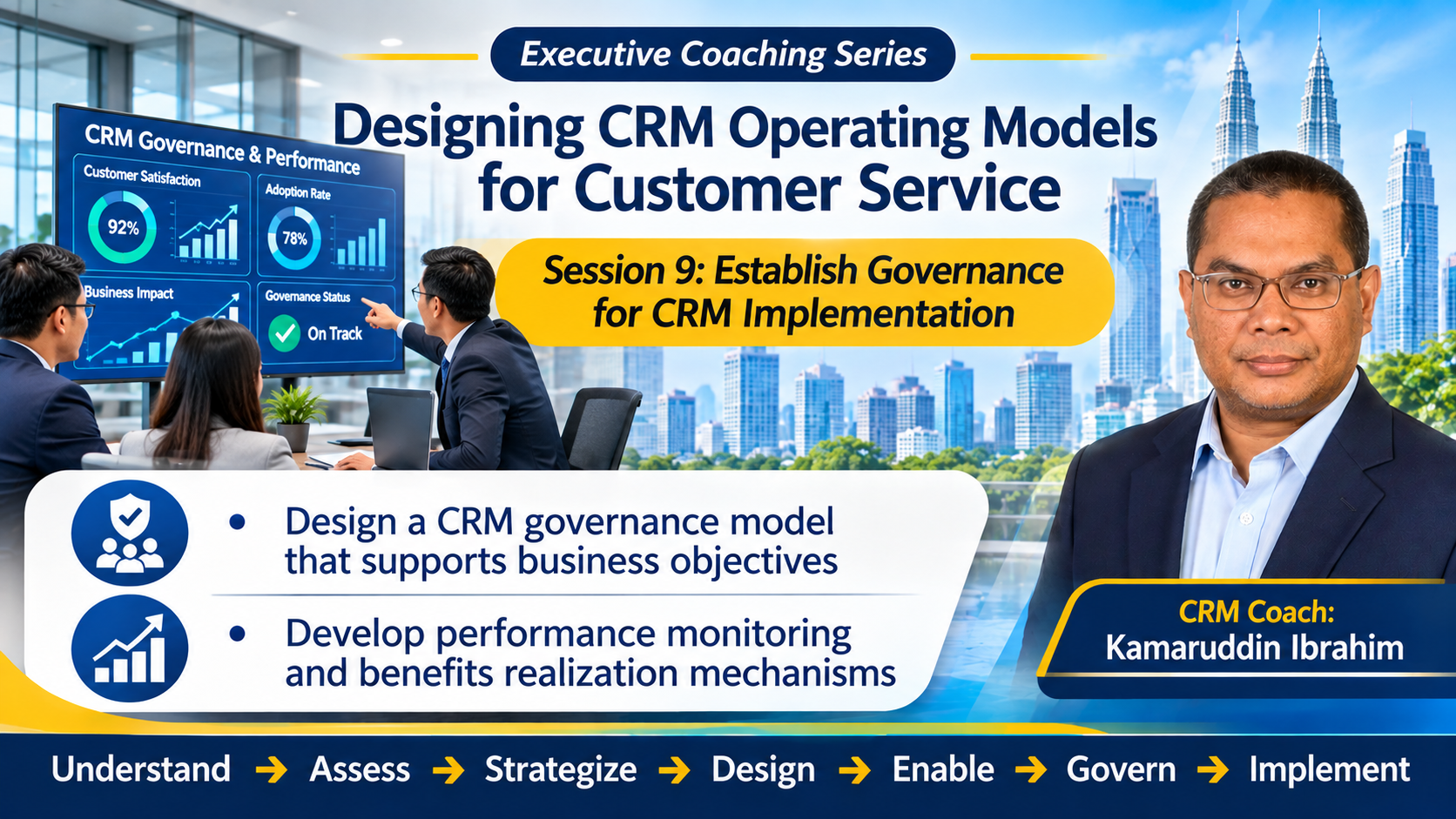
Session 9: Establish Governance for CRM Implementation (2 Hours Coaching)
As customer expectations continue to evolve, organizations must deliver consistent, efficient and personalized service across every touchpoint. A well-designed CRM Operating Model is essential to ensure that customer service operations are not only aligned with strategic goals but also enabled by the right technology, data, processes, change management practices and governance. This executive coaching series is designed for senior leaders, managers, customer service professionals and transformation teams who wish to establish or enhance their Customer Relationship Management (CRM) capabilities within customer service operations. Through ten guided coaching sessions, participants will assess their organization's CRM maturity and readiness, formulate a practical CRM strategy, design customer-focused processes, define supporting data and technology requirements and establish the governance and change management practices needed for successful implementation. Each session combines executive coaching, practical workshops and real business application to help participants progressively develop a CRM Operating Model tailored to their organizational needs. The coaching sessions follow the logical progression of a CRM transformation journey: Understand → Assess → Strategize → Design → Enable → Govern → Implement Each session will be conducted as a 120-minute coaching session, comprising: 30% Knowledge Transfer 40% Guided Discussion 20% Practical Workshop 10% Coaching Feedback and Assignment Review Session 9: Establish Governance for CRM Implementation (2 Hours Coaching) A well-designed CRM strategy, supported by effective processes, high-quality data, enabling technology and strong user adoption, can still fail without appropriate governance. Governance ensures that CRM remains aligned with business objectives, customer experience goals, operational requirements and organizational priorities long after implementation is completed. This session focuses on designing the governance structures, roles, decision rights, accountability mechanisms and operating rhythms required to sustain CRM success. Participants will learn how governance provides oversight, drives alignment, manages competing priorities, protects data integrity and supports continuous improvement across the CRM ecosystem. Rather than viewing governance as a control mechanism, participants will explore how governance acts as the leadership framework that guides CRM investments, business decisions, process changes, technology enhancements and adoption activities throughout the CRM lifecycle. This session brings together the outputs from all previous sessions and establishes the organizational structures needed to operate, maintain and continuously improve the CRM Operating Model. Objectives Understand the role of governance in sustaining CRM success. Establish governance structures that support strategic alignment and accountability. Define key roles, responsibilities and decision rights. Design governance processes that support continuous improvement. Create operating rhythms that ensure effective oversight and value realization. Align governance with the CRM Operating Model and transformation roadmap. Learning Outcomes Upon completion of this session, participants will be able to: Explain the importance of CRM governance in long-term success. Design a CRM governance model that supports business objectives. Define governance roles, accountabilities, and decision-making authority. Establish governance forums and operating routines. Develop performance monitoring and benefits realization mechanisms. Create a framework for continuous improvement and ongoing CRM evolution.

How it works
- 1. Pick your hoursChoose from Kamaruddin's free hours and pay online.
- 2. Say what you needYour note helps them prepare.
- 3. MeetOnline from your booking, or at the place you agree. We remind you a day and an hour before.
About this coaching
As customer expectations continue to evolve, organizations must deliver consistent, efficient and personalized service across every touchpoint. A well-designed CRM Operating Model is essential to ensure that customer service operations are not only aligned with strategic goals but also enabled by the right technology, data, processes, change management practices and governance.
This executive coaching series is designed for senior leaders, managers, customer service professionals and transformation teams who wish to establish or enhance their Customer Relationship Management (CRM) capabilities within customer service operations. Through ten guided coaching sessions, participants will assess their organization's CRM maturity and readiness, formulate a practical CRM strategy, design customer-focused processes, define supporting data and technology requirements and establish the governance and change management practices needed for successful implementation. Each session combines executive coaching, practical workshops and real business application to help participants progressively develop a CRM Operating Model tailored to their organizational needs.
The coaching sessions follow the logical progression of a CRM transformation journey:
Understand → Assess → Strategize → Design → Enable → Govern → Implement
Each session will be conducted as a 120-minute coaching session, comprising:
- 30% Knowledge Transfer
- 40% Guided Discussion
- 20% Practical Workshop
- 10% Coaching Feedback and Assignment Review
Session 9: Establish Governance for CRM Implementation (2 Hours Coaching)
A well-designed CRM strategy, supported by effective processes, high-quality data, enabling technology and strong user adoption, can still fail without appropriate governance. Governance ensures that CRM remains aligned with business objectives, customer experience goals, operational requirements and organizational priorities long after implementation is completed.
This session focuses on designing the governance structures, roles, decision rights, accountability mechanisms and operating rhythms required to sustain CRM success. Participants will learn how governance provides oversight, drives alignment, manages competing priorities, protects data integrity and supports continuous improvement across the CRM ecosystem.
Rather than viewing governance as a control mechanism, participants will explore how governance acts as the leadership framework that guides CRM investments, business decisions, process changes, technology enhancements and adoption activities throughout the CRM lifecycle.
This session brings together the outputs from all previous sessions and establishes the organizational structures needed to operate, maintain and continuously improve the CRM Operating Model.
Objectives
- Understand the role of governance in sustaining CRM success.
- Establish governance structures that support strategic alignment and accountability.
- Define key roles, responsibilities and decision rights.
- Design governance processes that support continuous improvement.
- Create operating rhythms that ensure effective oversight and value realization.
- Align governance with the CRM Operating Model and transformation roadmap.
Learning Outcomes
Upon completion of this session, participants will be able to:
- Explain the importance of CRM governance in long-term success.
- Design a CRM governance model that supports business objectives.
- Define governance roles, accountabilities, and decision-making authority.
- Establish governance forums and operating routines.
- Develop performance monitoring and benefits realization mechanisms.
- Create a framework for continuous improvement and ongoing CRM evolution.
What you'll get
- CRM governance model
- CRM performance monitoring and benefits realization mechanisms
Your trainer
I'm a CRM specialist with 21+ years of experience delivering transformation programmes across Asia Pacific. I help professionals and organisations unlock the full value of CRM, build CRM operating models and improve CRM adoption. Certified in AI for Business (Wharton) & Generative & Agentic AI (Oxford), I deliver consulting & training services that bridge AI & CRM for measurable business outcomes. Author: Predictive AI in Financial Services: From Idea to Impact (Amazon - https://a.co/d/7XfIV47).